Self-Improving AI Agent Skills | Self-Healing Agents with Cognee & n8n
The Hidden Crisis Killing Your AI Agents
Your code review agent just approved a pull request. It missed the missing ownership check. It ignored the absent 404 handling. It failed to flag the three test cases that should have been there.
Sound familiar? Here’s the thing about agent skills: they decay. Fast. That SKILL.md file you wrote six months ago? It’s already outdated. Your codebase evolved. Your API conventions shifted. Your migrations changed. But those Markdown instruction files? Static. Frozen in time.
Under deadline pressure, nobody audits agent skills manually. Critical checks slip through. Errors compound. And your “intelligent” agent becomes a liability.
What If Your Skills Could Heal Themselves?
Enter Cognee. It’s a memory layer for AI agents that doesn’t just store documents—it converts data from multiple formats into structured knowledge graphs. Instead of relying on conceptual similarity alone, Cognee extracts entities and maps relationships. It understands your code. Your conventions. Your evolving reality.
Now combine it with n8n, and you get something powerful: a self-improving loop that keeps your agent skills sharp without constant hand-holding.
How the Loop Works (No PhD Required)
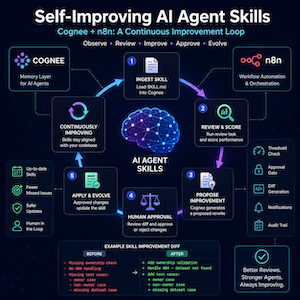
The process is elegant in its simplicity. You ingest a SKILL.md into Cognee. Run a review task with the skill loaded. Grade that review with a score. If the score falls below your configurable threshold, the system generates a proposed rewrite.
But here’s the critical part: it never applies automatically. Every change sits in holding status until you approve it. You see the before/after diff. You decide. The workflow never silently rewrites skill files.
The Cognee verified node in n8n provides six operations: Ingest Skill, Review Skill, Propose Improvement, Get Proposal, Apply Improvement, and Get Skill. n8n handles the orchestration—scoring, threshold comparison, approval gating, diff generation, notifications, and branching logic. The threshold check lives in n8n too, making it trivial to swap in stricter evaluators like an LLM-as-judge node or a CI score without touching your Cognee steps.
Two Paths to Implementation
You can build this visually using n8n’s editor with Cognee Cloud or a self-hosted server. The Cognee node v0.5.1 or higher installs directly from the n8n editor. You’ll need API credentials—a Base URL and API key from your Cognee Cloud tenant dashboard at platform.cognee.ai. Cognee Cloud is fully managed and serverless, with model and embedding providers handled automatically.
Prefer code? Use the Cognee Python SDK—remember, improve_skill, and related methods—wired through Execute Command nodes. The advanced SDK build runs entirely on self-hosted infrastructure: self-hosted n8n, self-hosted Cognee server, and local LLM and embedding models. You’ll need n8n 2.x to explicitly enable Execute Command nodes.
See It in Action
Picture this scenario. You have a code-review skill. You run an authorization-boundary review task. The agent should flag missing ownership checks, absent 404 handling, and missing owner/non-owner/missing-dataset tests. But it doesn’t. The score comes back low.
Cognee generates a proposal. n8n shows you the diff. You see exactly what needs changing. You click approve. The skill updates. Next review? Your agent catches everything.
A single weak review can never silently rewrite instructions because Propose Improvement creates a proposal in holding status, and Apply Improvement only executes after the Approved? gate passes.
From Demo to Production
The demo uses manual controls, but production adaptations are straightforward. Replace those with Webhook Triggers. Post diffs to Slack. Add Wait nodes for webhook approval. Integrate GitHub branch and pull request workflows for skill changes. Build datastore audit trails for accepted and rejected proposals.
Your skills evolve with your codebase. Automatically. Safely. With you in control.
Your Move
Skill rot isn’t inevitable. It’s a choice. You can keep patching agents that drift further from reality every sprint. Or you can build a system that adapts, learns, and improves—while keeping you firmly in the driver’s seat.
The Cognee verified node is waiting in your n8n editor. Version 0.5.1. Ready when you are.