
Learn the two-layer architecture behind resilient AI agents, including retries, circuit breakers, fallbacks, and LLM-powered recovery based on n8n’s latest production best practices.
Your AI agent just broke in production at 2 a.m. Again. A text alert drags you out of bed. The logs show a cryptic 503, the token meter is spinning, and your user is staring at a blank screen. But what if your system fixed itself before you even rolled out of bed?
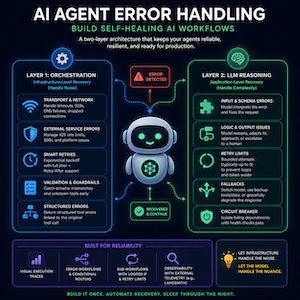
n8n published an official guide on July 3, 2026, that treats error handling like a military briefing. Their advice is built on a two-layer architecture. Orchestration owns infrastructure-level retries silently. The LLM owns reasoning-based recovery for application-level problems that require context. You don’t need a single hero. You need a clean chain of command, because four distinct failure categories are waiting to test your code in production.
The Silent Fixes You Never See
Transport and network failures, dropped connections, 503s, DNS timeouts, these are transient ghosts. Orchestration swallows them silently, and the LLM never knows anything happened. The same layer handles external service errors like 429 rate limits and 500 platform crashes by inspecting response headers and parsing Retry After values. It pairs this with exponential backoff and full jitter so your retries never stampede the endpoint in a thundering herd. Your agent keeps moving even when the web hiccups.
But orchestration does more than wait. It actively parses standard Retry After headers to stay compliant with third-party limits. When things go sideways, structured error messages pass back as tool results tied to the original tool call IDs rather than catching exceptions and stopping execution cold. Schema mismatches and hallucinated tool names get intercepted before they poison the conversation, and the system injects a corrective feedback loop directly into the conversation history. No exceptions. No dead air. The pipeline survives while others break.
When the Model Must Wake Up
Some wounds need a brain, not a bandwidth limiter. Input validation failures, schema mismatches, or a 400 Bad Request cannot be repaired by orchestration alone. The model reads the error, adjusts its reasoning, and emits a corrected request. Logic errors and unexpected outputs, like zero records or malformed JSON, push the agent to reason through the failure, adapt its path, or escalate to a human when judgment is required. Otherwise your model burns cash reasoning about network noise it cannot fix.
This recovery loop wears handcuffs. Hard retry counters, typically three attempts, prevent infinite execution loops and rapid token consumption. If the model still stalls, fallback chains exist at two levels. Swap to a secondary model provider. Route to a backup tool or database. Graceful degradation catches the tool failure and instructs the model to deliver partially completed high-value output instead of returning a naked error to your user.
Then there is the circuit breaker. It tracks sequential failures across agent runs inside a distributed state machine and isolates broken dependencies until health checks confirm they are safe. That distributed memory means one broken tool cannot sink an entire fleet. One bad vendor does not kill the workflow. n8n supports these patterns natively through node-level retries, error workflows with conditional fallback routing, and visual execution traces. For advanced retry strategies, you wrap AI Agent tools into sub-workflows using looped IF nodes with strict upper retry limits.
One honest gap remains. Full model-level hidden reasoning traces still require an external telemetry layer like LangSmith, even with n8n visual traces. The blueprint is visible, but the black box needs its own lens.
You do not need a PhD to build agents that survive the real world. You need two layers, three attempts, and the humility to let infrastructure handle the noise while the model handles the nuance. Build it once. Sleep through the night.