SAP Invests €60M in n8n: Why Your Workflows Will Never Be the Same
SAP Just Bet €60 Million on This Berlin Automation Startup—Here’s Why Your Workflows Will Never Be the Same and Your automation tool just became enterprise-grade.
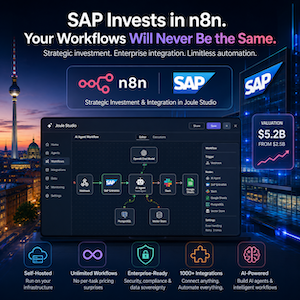
When SAP announced its strategic investment in n8n on May 31, 2026, the €60 million injection didn’t just double the Berlin-based company’s valuation to $5.2 billion. It signaled something bigger: visual workflow automation is no longer a nice-to-have. It’s the core infrastructure every serious business needs.
The Journey from $2.5 Billion to $5.2 Billion
Founded in 2019, n8n emerged from Berlin with a radical premise. Give users a visual canvas to connect APIs, services, and databases—then let them run it anywhere. On cloud servers or their own hardware. With code or without. This fair-code licensing model kept the core platform free to use and self-host while generating sustainable revenue through cloud hosting tiers and enterprise support services.
The bet paid off—spectacularly. In October 2025, n8n announced an $180 million Series C funding round led by Highland Europe. Nvidia’s venture investment arm joined in, highlighting n8n’s position as a significant player in the AI and automation infrastructure space. That round valued the company at approximately $2.5 billion. For nearly eight months, n8n operated as a multi-billion-dollar heavyweight quietly expanding its capabilities.
Then SAP arrived at their annual Sapphire conference with different plans entirely.
The German enterprise giant didn’t just write a check. They rewrote n8n’s trajectory. The strategic investment, announced alongside broader AI and data cloud initiatives at Sapphire 2026, injected roughly 60 million euros and catapulted n8n’s valuation to $5.2 billion. Overnight, n8n became one of Germany’s most valuable AI startups and one of the highest-valued open-source infrastructure companies globally.
Inside Joule Studio: Where Your Automations Meet SAP’s Empire
SAP isn’t keeping n8n at arm’s length. They’re embedding it directly into Joule Studio—the development environment where customers and partners build custom AI agents that operate within SAP’s ecosystem. Joule itself serves as SAP’s AI copilot and generative AI assistant, integrating across the entire enterprise software suite including S/4HANA, SuccessFactors, and other cloud solutions touching millions of business users worldwide.
Think about what this means practically. You won’t need specialized ABAP developers or complex custom integration code to bridge SAP systems with modern SaaS tools. The same visual workflow builder that n8n users love—supporting over 400 integrations with third-party services, databases, messaging platforms, and APIs—will now sit inside the world’s most entrenched enterprise software.
Industry analysts call this the largest enterprise software validation of an open-source workflow automation platform to date. SAP had the resources to build competing orchestration tools internally. They chose n8n instead, considering visual workflow builders essential to their AI strategy rather than developing competing technology. That endorsement carries weight—especially since strategic investments of this nature typically involve both capital infusion and deep product integration roadmaps spanning multiple years.
The Technical Reality That Won This Deal
n8n didn’t secure this valuation with pretty diagrams alone. Under the hood, the platform handles complexity that breaks lesser tools. It supports sophisticated logic including branching, loops, error handling, and custom JavaScript expressions within workflow nodes. Webhook triggers, scheduled executions, and event-driven architectures make it suitable for both batch processing and real-time automation scenarios.
Then there’s the AI layer. While traditional competitors focus on simple trigger-action sequences, n8n supports AI agent workflows through nodes for large language models, vector databases, and retrieval-augmented generation. It handles traditional automation and emerging AI use cases on the same canvas. This dual capability positioned n8n perfectly for SAP’s AI strategy unveiled at Sapphire 2026, suggesting that workflow automation is a core pillar of SAP’s modernization efforts for the AI era.
The Self-Hosting Advantage You Can’t Buy Elsewhere
Here’s where n8n diverges sharply from proprietary alternatives like Zapier and Make. While those platforms charge per-task pricing and lock you into their infrastructure, n8n’s open-source model allows users to run unlimited workflows without usage-based fees.
For roughly $5 to $30 monthly, you can deploy self-hosted n8n on popular providers like Hostinger VPS, xCloud or Railway. The technical requirements are modest: a server with at least 2 CPU cores and 4GB of RAM. The platform provides an official Docker image with docker-compose configurations that simplify deployment on standard Linux VPS instances, making setup straightforward for teams with basic Linux administration skills.
This matters immensely if you work in regulated industries. Manufacturing. Logistics. Finance. SAP dominates these sectors, and their customers often face strict data residency and compliance requirements. Self-hosted n8n runs entirely on your own infrastructure without relying on third-party cloud services. Your data never leaves your servers. No per-task pricing surprises appear as your automation volume grows. This self-hosting option is particularly relevant for enterprises with data sovereignty requirements.
What Your Team Gains Tomorrow
If you’re already running n8n—particularly those self-hosting the open-source version—SAP’s backing changes your risk equation. Enterprise credibility just arrived without requiring changes to existing licensing or self-hosting models. You gained a multi-billion-dollar validation from a software giant that suggests long-term platform stability.
For SAP’s existing customer base, the Joule Studio integration exposes visual workflow builders to millions of business users who may never have considered automation tools before. The n8n community maintains extensive documentation and example workflows on GitHub, contributed by developers who’ve added nodes, integrations, and documentation that extend the platform beyond the core team’s maintenance. This community-sourced knowledge lowers the barrier to entry for business users familiar with their applications but new to automation.
The partnership could significantly accelerate adoption of n8n in regulated industries such as manufacturing, logistics, and finance, where SAP already has deep market penetration. When compliance teams understand that automation can run on existing infrastructure under existing security protocols, approval processes shorten dramatically.
Your Move
The partnership announced at Sapphire 2026 represents more than a funding milestone. It’s a declaration that workflow automation is essential infrastructure, not experimental technology. SAP spent 60 million euros to avoid building this capability internally. They recognized what n8n users already knew: the combination of visual design, code flexibility, and deployment freedom creates capabilities that proprietary platforms cannot match.
Whether you’re automating simple Slack notifications or orchestrating complex ERP workflows across S/4HANA instances, the barrier just dropped. You no longer need specialized integration skills, enterprise middleware budgets, or compliance exemptions. The tools exist. The validation is complete. The infrastructure is ready.
The only question left: What will you automate first?