
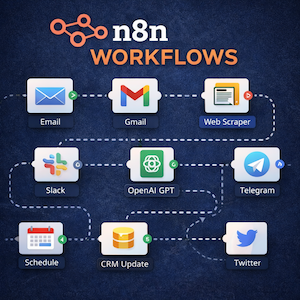
You are losing nearly a full workweek every month to tasks that could run themselves while you sleep. It’s not your fault. Most professionals spend hours copying data between spreadsheets, manually sorting emails, and triggering social media posts at odd hours because they believe automation requires a computer science degree. They look at complex code repositories and assume that level of technical expertise is the entry fee.
Here’s the thing: n8n workflows can reclaim 20 to 50 hours of your week without forcing you to write a single line of code, provided you deploy them on infrastructure you actually control. The barrier isn’t technical ability. It’s simply knowing where to start.
The Hidden Tax on Your Time
Manual work isn’t just tedious. It’s expensive. Finance teams spend eight hours processing invoices that could take ninety minutes if the data extraction and entry happened automatically. Marketing directors at companies like TechFlow Solutions admit they were drowning in social media scheduling until smart automation cut their management time by seventy percent. These are not edge cases or futuristic fantasies. They are the daily reality for automation builders, agencies, and entrepreneurs who have not yet built systems that scale.
When you calculate the cost of that labor at competitive hourly rates, the waste becomes painful to ignore. Every hour spent on mechanical repetition is an hour stolen from strategy, client relationships, or product development. You did not start your business or career to become a data entry clerk. Yet that’s exactly what happens when automation infrastructure remains an afterthought.
Workflows That Actually Move the Needle
Let’s get specific about what these time savings look like in practice. Invoice processing automation uses OCR through services like Mindee or Google Cloud Vision API to extract data from emails or Google Drive uploads automatically, eliminating the manual typing that creates bottlenecks at month-end. Sarah Chen, a Marketing Director, implemented an AI-powered email workflow that categorizes incoming messages, drafts responses to common inquiries, and routes urgent items to the right team members without human intervention.
Social media workflows post at optimal times consistently, improving engagement rates while eliminating the midnight scheduling sessions that wreck your sleep schedule. Lead enrichment workflows automatically populate your CRM with data that used to require twenty minutes of research per prospect. Each workflow acts like a reliable employee who never sleeps, never calls in sick, and costs a fraction of a human salary while working at machine speed.
Architecture That Scales
Most people build their first n8n workflows like they are constructing a tower without blueprints. They create monolithic monsters with fifty nodes that break whenever one API updates or a field name changes. Smart builders do the opposite. They break complex processes into sub-workflows of five to ten nodes each, using the Execute Workflow node to connect them like Lego blocks that snap together cleanly. This modular approach lets you isolate and test components separately, making debugging faster and more precise when something inevitably goes wrong.
Your automation architecture determines whether you spend weekends fixing broken pipelines or enjoying them with family. Recent data shows that over seventy-eight percent of organizations now automate critical workflows, but only twenty-two percent have optimized their architecture for maintainability and security. That gap represents your competitive advantage in a market where speed and reliability separate the professionals from the amateurs.
Why Your Hosting Choice Matters
You can’t build a racecar on a bicycle frame and expect to win championships. The same principle applies to automation infrastructure. When you self-host n8n on a VPS, you control exactly how workflows scale, where your sensitive data lives, and who can access it across your network. This isn’t an abstract technical preference in 2026. Data loss prevention is mandatory, and IBM research confirms the staggering costs associated with breaches that could have been prevented with private networking and proper container orchestration.
Providers like Hostinger, XCloud, n8nCloud, Railway, Cubepath, and Contabo offer one-click installations that get you running in minutes without sacrificing the control that enterprise security demands. You avoid the vendor lock-in of SaaS platforms while maintaining the flexibility to integrate sensitive internal systems that public cloud automation services cannot touch. Your infrastructure should empower your automation, not limit it.
The Implementation Reality Check
Starting is simpler than you think, but perfectionism kills progress. Pick one painful manual process, like email triage or invoice handling, and map it on paper with a simple flowchart. Then build a five-node workflow that handles just the repetitive core of that process. Test it with real data. Refine the logic. Once it runs smoothly for a week without errors, add the next module. This incremental approach prevents the overwhelm that kills most automation projects before they deliver value. Remember, the goal isn’t to automate everything on day one. It’s to reclaim those first ten hours so you can reinvest that time into building systems that reclaim the next forty hours. Momentum beats perfection every time.
Stop letting repetitive tasks consume your best thinking hours and creative energy. Deploy your first n8n workflow this week on a VPS you control, and watch your available time expand by twenty to fifty hours within thirty days. Your future self will thank you for the decision you make today. Start building.