n8n + Google A2A: Build Your Multi-Agent Command Center
How n8n Turns Google’s A2A Protocol Into Your Multi-Agent Command Center
What if your AI agents could talk to each other seamlessly, even when built on completely different frameworks?
That question stopped being hypothetical in April 2025. That’s when Google introduced the Agent-to-Agent (A2A) protocol, an open standard designed to let AI systems communicate across incompatible stacks. By June 17, 2026, the n8n team published their official guide.
They weren’t just documenting a spec. They were handing you the keys to orchestrate distributed multi-agent systems without writing fragile custom integrations.
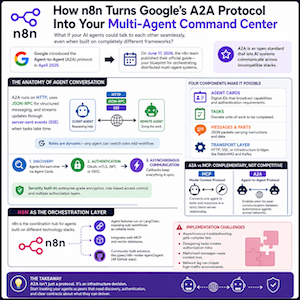
The Anatomy of Agent Conversation
Here’s how it actually works. A2A runs on HTTP as its backbone, uses JSON-RPC for structured messaging, and streams updates through server-sent events (SSE) when tasks take time. But the magic happens in the architecture.
Every interaction revolves around two roles: the client agent requesting help, and the remote agent doing the work. Crucially, these aren’t fixed positions. Any agent can switch roles dynamically mid-workflow.
Four components make this possible. Agent cards act as digital IDs, broadcasting capabilities and authentication requirements. Without a valid card, integration fails immediately. The system cannot verify what an agent can do or if it should be trusted. Then there are tasks (discrete units of work), messages and parts (JSON packets carrying instructions), and the transport layer itself (HTTP, SSE, or message brokers like RabbitMQ and Kafka).
From Discovery to Deployment
The protocol follows a rigid sequence. First comes discovery through agent cards. Then authentication via OAuth, mTLS, JWT, or OIDC. Finally, asynchronous communication begins with callbacks keeping everything synchronized. Security isn’t an afterthought here. Enterprise-grade encryption, role-based access control, and multiple authorization layers come standard.
Now, you might wonder how A2A differs from MCP, the Model Context Protocol. Here’s the distinction: MCP connects one agent to tools and resources in a strict client-server relationship. A2A enables peer-to-peer communication between autonomous agents across networks. They’re complementary, not competitive.
n8n as the Orchestration Layer
This is where n8n steps in. They’ve positioned their platform as the coordination hub for agents built on different technology stacks. Their agent features run on LangChain, exposing sub-workflows as callable tools. They integrate with MCP and vector databases. And their community has already built protocol-level solutions like pjawz/n8n-nodes-agent2agent, which has garnered 48 GitHub stars.
But implementation isn’t painless. Asynchronous troubleshooting gets complex fast. Delegating tasks creates authorization risks. Malformed messages cause context loss. Network lag can cripple high-traffic environments.
The takeaway? A2A isn’t just a protocol. It’s a infrastructure decision. Start treating your agents as peers that need discovery, authentication, and clear contracts about what they can deliver.