A Game Changer for Businesses
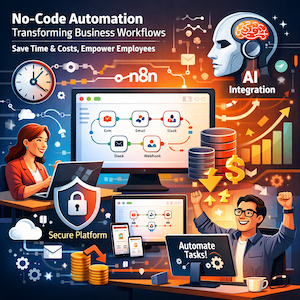
You’re losing nearly half your workweek to mindless repetition. Clicking through spreadsheets. Chasing approvals via email threads that stretch into infinity. Copying data from one system to another while praying you don’t introduce a catastrophic error. It’s exhausting, expensive, and entirely unnecessary.
Here’s the thing: you don’t need a computer science degree to fix it anymore. You don’t need to wait six months for an engineering team to prioritize your request. The tools to automate your most tedious workflows are sitting right in front of you, disguised as simple visual interfaces that respond to plain English.
The Old Way Is Broken
Remember when building software meant hiring expensive developers, waiting months for delivery, and praying the final product actually matched your vision? That model is crumbling under its own weight. Organizations currently waste an average of 40% of their time on manual, repetitive tasks. That’s two full days every week spent on work that doesn’t move the needle, doesn’t spark joy, and certainly doesn’t drive innovation. Your HR manager knows exactly what the onboarding process should look like.
Your finance lead understands the approval hierarchy better than any outsourced consultant. Yet for decades, they’ve had to translate these insights through layers of technical gatekeepers who speak a different language. No-code automation rips down that barrier completely. It hands the reins to the people who actually understand the business, letting them build solutions in hours instead of quarters, test them immediately, and iterate without incurring massive consulting fees.
What “No-Code” Really Means in Practice
Workflow automation software spans a broad spectrum, from enterprise BPM platforms like ProcessMaker to sophisticated visual app builders like WeWeb. But the core promise remains consistent across all of them: if you can describe what you want, you can create it. Imagine typing into a system, “Every Friday, email a sales summary to the management team using data from our CRM,” and watching that automation construct itself automatically. This isn’t science fiction or a beta feature hiding behind a waitlist.
It’s happening right now in companies of every size. Business users, often called citizen developers, are building everything from simple task automations to complete, customer-facing web applications without writing a single line of Python, JavaScript, or SQL. The rise of no-code represents a fundamental democratization of technology, empowering marketers, operations leads, and HR managers to construct the exact tools they need without waiting for permission or resources from centralized IT departments.
Speed, Savings, and the Bottom Line
The advantages center on three undeniable factors that directly impact your P&L: velocity, cost reduction, and empowerment. Gartner forecasted the low-code development technologies market would exceed $30 billion by 2024, positioning these tools among tech’s fastest-growing segments for good reason. The development speed improvements are genuinely transformative. Front-end workflows and prototypes that once required three months of development sprints now take three days of configuration.
Instead of submitting tickets into a black hole and waiting for IT availability, your operations manager can spin up an approval workflow before lunch and have it processing real transactions by dinner. You save on contractor costs that typically range from $150 to $300 per hour. You eliminate the translation errors that happen when business requirements pass through multiple technical filters and emerge unrecognizable. Most importantly, you validate ideas quickly. Build a functional prototype in WeWeb to test with real users before committing serious engineering resources to a solution that might miss the mark.
When Artificial Intelligence Joins the Party
Here’s where your pulse should quicken and your competitive instincts should kick into high gear. The integration of AI with no-code platforms is creating capabilities that seemed impossible just eighteen months ago. We’re seeing the emergence of “prompt to app” generation, where natural language commands spawn functional workflows instantly without you touching a single configuration menu. This synergy is so powerful that 79% of leaders believe generative AI will improve their process automation efficiency by at least 25% within the next year.
AI excels at handling time-consuming processes like data entry, document classification, and scheduling, while no-code platforms enable you to design the custom workflows that manage and streamline these tasks effectively. The result is a beautiful convergence where natural language, design assets, and structured code meet, bridging the gap between your business teams and technical departments while maintaining the governance and scalability that enterprises demand.
Who’s Actually Using This Right Now?
Finance teams are streamlining month-end close, reconciliation, and forecasting without waiting for expensive ERP customizations. Engineering enablement teams are standardizing internal workflows to reduce cognitive load and context switching. Executives are finally gaining real-time visibility and control over automation across the organization instead of relying on quarterly reports.
Take ProcessMaker, for instance. This BPM platform centers on BPMN modeling, dynamic forms, and robust workflow execution, allowing you to map complex business processes visually while maintaining strict compliance standards. Or consider WeWeb, designed specifically for professionals who need both the speed of visual building and the power of sophisticated logic and integrations.
These aren’t toys for weekend hobbyists. They’re enterprise-grade solutions equipped with robust security features including role-based access control, comprehensive audit logs, military-grade data encryption, and self-hosting options for air-gapped environments. Your IT team doesn’t lose control when you adopt these tools; they gain a force multiplier that lets them focus on infrastructure while business units handle their own domain logic.
Addressing the Security Reality Check
Let’s address the elephant in the room that keeps CTOs awake at night. When you empower business users to build solutions, don’t you sacrifice security, governance, and data integrity? Not anymore. Leading platforms maintain enterprise security and privacy controls that rival traditional development stacks, including end-to-end encryption and granular RBAC (Role-Based Access Control). You get immutable audit trails showing exactly who changed what workflow and when. You can deploy on private clusters for sensitive healthcare or financial data.
The enterprise plans offer custom pricing for complex use cases, private infrastructure, and access management for both internal and external users. The best tools make it easy for anyone on your team to build, run, and manage smart workflows without writing code, yet remain simple enough for business users and powerful enough for Fortune 500 security requirements. You don’t have to choose between agility and governance. You get both, served together.
You don’t need a crystal ball to predict the future of your business. You need to build it. Start with one broken process. One manual report that drains an hour from your team every single week. Build the automation. Watch it run while you sleep. Then ask yourself why you ever tolerated the old way for so long.
For those ready to get started with automation and experience the power of no-code automation today, explore our quick start guide and take the first step to transform your workflows.