
Department-level AI wins are only the beginning. Discover why disconnected AI systems prevent enterprise-scale transformation—and how AI orchestration bridges the gap between isolated automation and organization-wide intelligence
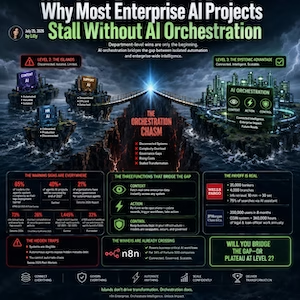
You’ve automated the content pipeline. Your support tickets route themselves. New hires onboard while you sleep. Your team celebrates these departmental wins, and they should. But here’s the uncomfortable truth: if these systems don’t talk to each other, you’re trapped at Level 2. And Level 2 is exactly where AI initiatives suffocate.
The Hardest Leap in Enterprise AI
n8n defines the jump from Operational to Systemic AI as the “orchestration chasm.” It’s the hardest leap in enterprise maturity. Most plateau here. They fail here. Level 2 organizations flaunt real departmental victories—AI-generated content, automated ticket triage, seamless onboarding—but each tool stands alone. No connection to sales. No handshake with finance. Just digital islands floating in the same enterprise sea.
The warning signs flash red. KPMG’s Q4 2025 AI Pulse Survey found 65% of leaders cite agentic system complexity as their top deployment barrier. That number hasn’t budged for two consecutive quarters. Meanwhile, Gartner predicts over 40% of agentic AI projects will be canceled by the end of 2027 due to escalating costs, unclear business value, and inadequate risk controls. The graveyard grows daily.
The Governance Gap Is Killing Momentum
Deloitte’s 2026 State of AI in the Enterprise report exposes deeper cracks. Only 21% of organizations possess mature governance models for autonomous agents. Yet 73% rank data privacy and security as their top concern. The same study reveals 84% of companies haven’t redesigned jobs around AI capabilities. The Cloud Security Alliance’s 2025 assessment delivers the knockout: just 26% maintain comprehensive AI security governance policies.
So why the urgency? Because demand is exploding while foundations crumble. Gartner reported a staggering 1,445% surge in client inquiries about multi-agent systems from Q1 2024 to Q2 2025. Forrester responded by launching its Agent Control Plane research stream and announcing a dedicated market evaluation for the orchestration category. Forrester further predicts that by the end of 2026, about a third of B2B payment workflows will use autonomous AI agents for supplier disputes, invoice matching, and payment reconciliation.
The Three Functions That Bridge the Gap
The bridge across the chasm is orchestration. Not another standalone tool. A connective layer providing three critical functions. Context: fetching real-time enterprise data instantly. Action: performing write operations like updating CRM records or processing refunds. Control: keeping business logic within your infrastructure so AI models remain swappable, secure, and governed.
The payoff justifies the crossing. Wells Fargo deployed an AI assistant to 35,000 bankers across roughly 4,000 branches. Information retrieval dropped from up to 10 minutes to about 30 seconds. Roughly 75% of relevant searches now flow through the agent. JPMorgan Chase built LLM Suite and onboarded 200,000 users within eight months. Their COiN system performs the equivalent of 360,000 hours of legal and loan-officer work annually.
But beware the hidden traps. Sweep’s 2025 post-mortem of stalled initiatives found companies failed because their systems were illegible. Autonomous agents exposed years of hidden metadata debt buried in platforms like Salesforce. You cannot automate chaos.
The winners already know this. n8n Enterprise now powers business-critical AI workflows for 34% of Fortune 500 companies. They’ve crossed the chasm. They’ve connected the islands. The question remains: will you bridge the gap, or plateau at Level 2?